Table of Contents
- The Conversion Rate Formula
- Worked Example
- Define Your Terms First
- How Conversion Rate Connects to Your Costs
- How Many Visitors Do You Need?
- What Is a Good Conversion Rate?
- How to Improve Conversion Rate
- How to Test Changes Properly
- Common Mistakes
- Example: Same Traffic, Two Pages
- Frequently Asked Questions
- How do you calculate conversion rate?
- What is a good conversion rate?
- What is the difference between conversion rate and click-through rate?
- Should I use sessions or users?
- How can I improve my conversion rate quickly?
- How is conversion rate linked to ROAS and CPL?
- Final Thoughts
Conversion rate is the share of visitors who take the action you want. The formula is conversions divided by visitors, times 100: if 150 of 5,000 visitors enquire, buy or sign up, your conversion rate is 3%. A "good" rate depends on the action, the traffic source and the price, so the best benchmark is your own history.
You can run your numbers with the free conversion rate calculator.
The Conversion Rate Formula
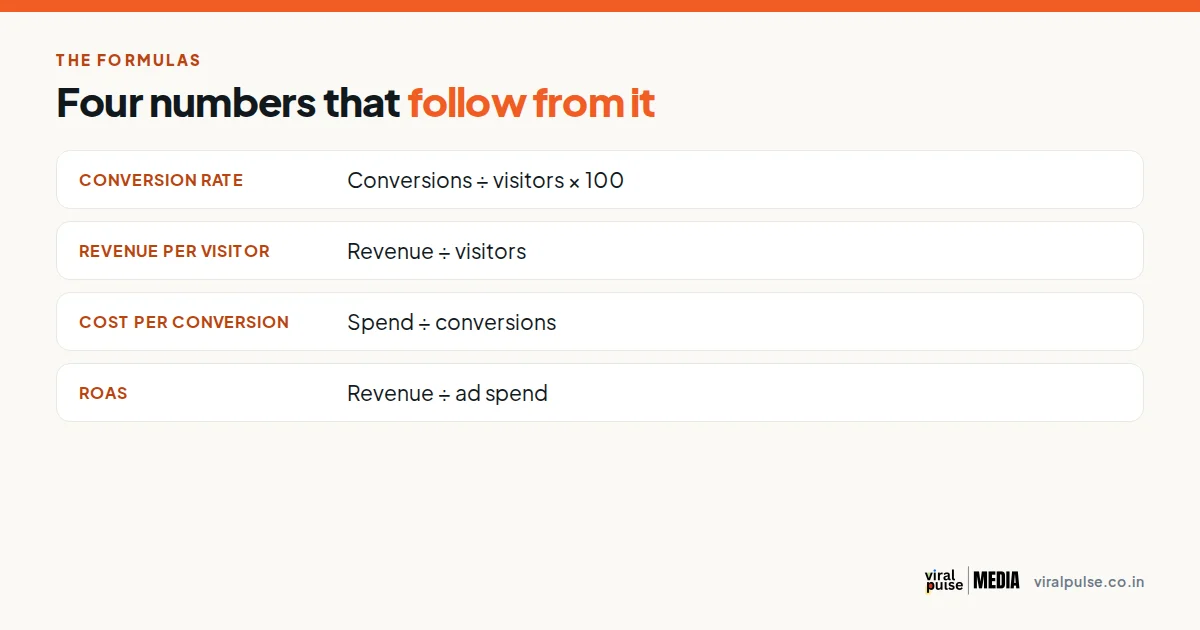
Conversion rate = (conversions ÷ visitors) × 100
Worked Example
A small online shop in Jaipur gets 5,000 sessions in a month.
- Orders: 150
- Revenue: ₹45,000
- Ad spend to bring the traffic: ₹20,000
150 ÷ 5,000 × 100 = 3%.
From the same numbers:
- Revenue per visitor: ₹45,000 ÷ 5,000 = ₹9
- Revenue per order: ₹45,000 ÷ 150 = ₹300
- Cost per order: ₹20,000 ÷ 150 = ₹133
- Return on ad spend: ₹45,000 ÷ ₹20,000 = 2.25x
Define Your Terms First
A conversion can be a purchase, a form fill, a call, a sign-up, a download or an add to cart. A visitor can be a session, a unique user or a click. The rate only means something if you use the same definitions each time.
- Sessions-based rate: conversions ÷ sessions. Common in web analytics.
- Users-based rate: conversions ÷ unique users. Lower when people visit several times before converting.
- Click-based rate: conversions ÷ ad clicks. Common in ad reports.
Choose one, write it down and do not mix them when comparing periods.
How Conversion Rate Connects to Your Costs
Cost per conversion equals the cost per visitor divided by the conversion rate. That means a higher rate lowers your cost without touching your ads.
Example: you pay ₹4 per visitor.
- At a 2% conversion rate, each conversion costs ₹4 ÷ 0.02 = ₹200.
- At 3%, it costs ₹4 ÷ 0.03 = ₹133.
- At 4%, it costs ₹100.
The same traffic, a 50% higher rate and a one-third lower cost. This is why many teams fix the page and the offer before buying more visitors. If your conversions are enquiries, the same logic gives you cost per lead, and for sales it feeds your return on ad spend.
How Many Visitors Do You Need?
Work backwards from a target. If you want 300 conversions a month and your rate is 3%, you need 300 ÷ 0.03 = 10,000 visitors. If traffic of that size is expensive, a rate of 4% brings the need down to 7,500 visitors. The calculator does this for you when you enter a target.
What Is a Good Conversion Rate?
There is no honest single number. Rates differ widely by:
- The action: a newsletter sign-up converts far more often than a high-priced purchase.
- The source: warm traffic from email or repeat visitors converts better than cold traffic from ads.
- The price and the trust involved: the more money or commitment you ask for, the lower the rate.
- The device and country: mobile and desktop often differ, and so do markets.
Published benchmarks exist, but many do not name their sample or definitions, and most come from US stores. If you use one, check that it states its source, period and industry, and treat it as a rough range, not a target. Better questions are: what was our rate last month, how does it differ by source and device, and where in the funnel do people drop off?
How to Improve Conversion Rate
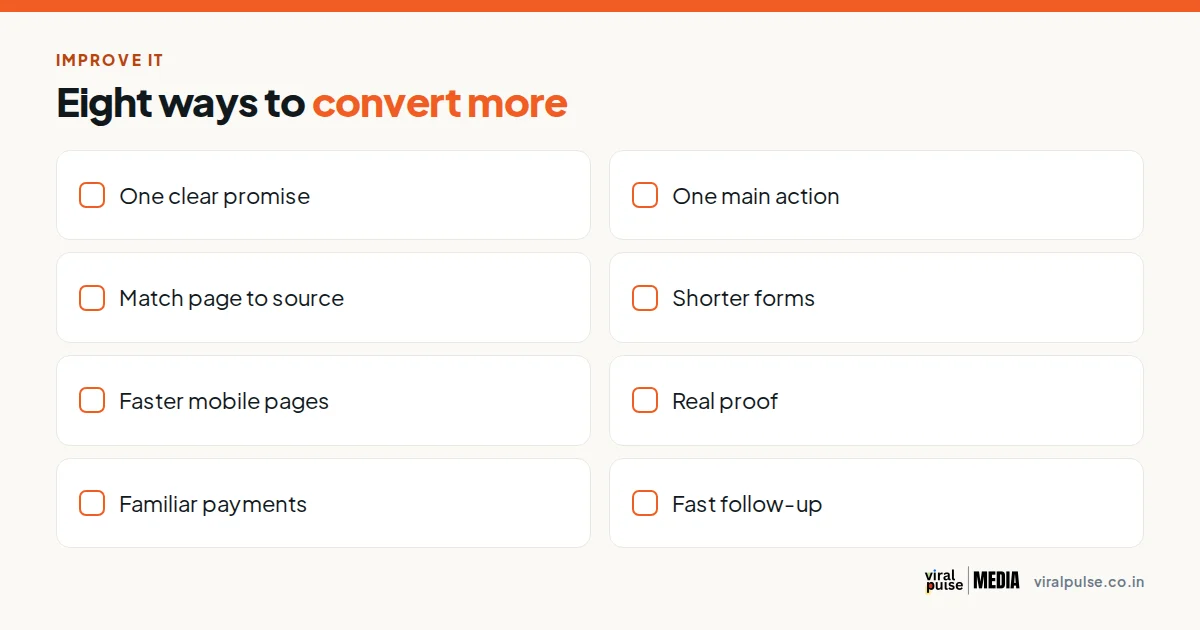
- Make one clear promise. The headline should say what the visitor gets, in plain words.
- Offer one main action. Many competing buttons split attention.
- Match the page to the source. A visitor from an ad about a specific product should land on that product, not the home page.
- Shorten forms and steps. Every extra field or step loses some people. Ask only what you need to follow up.
- Speed up mobile pages. Most Indian traffic is on phones, and slow pages lose people before they see the offer.
- Show real proof. Genuine reviews, real photos, clear prices, delivery and refund terms reduce doubt.
- Offer familiar payment options. For stores, UPI and cash on delivery are often what people expect.
- Follow up fast. For lead forms, a reply within minutes often decides whether the lead becomes a customer.
How to Test Changes Properly
Change one thing at a time, run the test long enough to include a normal week and avoid stopping the moment one version looks ahead. With low traffic, small changes are hard to detect: you may need thousands of visitors per version. Use the A/B test sample size calculator to estimate it before you start, so you do not draw conclusions from noise.
Common Mistakes
- Changing the definition of a conversion or visitor between periods.
- Judging a page on a few dozen visitors.
- Mixing traffic sources into one average and missing that one source is far weaker.
- Stopping a test early because one version is ahead.
- Optimising the rate while ignoring order value and repeat purchases. Revenue per visitor captures both.
- Counting spam or test submissions as conversions.
Example: Same Traffic, Two Pages
| Page A | Page B | |
|---|---|---|
| Visitors | 4,000 | 4,000 |
| Conversions | 80 | 120 |
| Conversion rate | 2% | 3% |
| Ad spend | ₹16,000 | ₹16,000 |
| Cost per conversion | ₹200 | ₹133 |
Page B converts 50% more visitors and costs a third less per conversion with the same spend. Before concluding that B is better, check that the gap is larger than random variation for this sample size.
Frequently Asked Questions
How do you calculate conversion rate?
Divide conversions by visitors and multiply by 100. For example, 150 conversions from 5,000 visitors is a 3% conversion rate.
What is a good conversion rate?
It depends on the action, the traffic source and the price. Compare against your own history and similar campaigns rather than a single universal figure.
What is the difference between conversion rate and click-through rate?
Click-through rate is clicks divided by impressions. Conversion rate is conversions divided by visitors or clicks. One measures interest in the ad; the other measures what happens after the click.
Should I use sessions or users?
Either, as long as you use the same one consistently. Do not compare a sessions-based rate with a users-based one.
How can I improve my conversion rate quickly?
Clarify the headline and offer, cut form fields, match the page to the source, speed up mobile loading and add real proof. Then test one change at a time.
How is conversion rate linked to ROAS and CPL?
A higher conversion rate lowers cost per conversion and raises return on ad spend for the same traffic and budget.
Want More Results From the Traffic You Already Have?
We review your funnel, find where visitors drop off and fix the biggest leaks first.
Final Thoughts
Define your terms, measure by source and device, and improve one thing at a time. When you are ready, put your own numbers into the free conversion rate calculator.
Want this executed for you?
Our agency team builds and runs social engines for B2B and SaaS brands.
Written by Mehran Shahmiri
Founder of Viral Pulse Media. Started as a freelance social media marketer in 2021, and is based in Srinagar, Kashmir. Also founder of OpenLoop Systems.
Follow on LinkedIn →