Table of Contents
- The Cost Per Lead Formula
- Worked Example
- What Counts as a Lead?
- CPL, CPA, CAC and CPC: What Is the Difference?
- The Number That Matters: Break-Even CPL
- What Is a Good Cost Per Lead?
- How to Lower Your Cost Per Lead
- Mistakes to Avoid
- Example: Comparing Two Channels
- Frequently Asked Questions
- What is cost per lead?
- How do you calculate cost per lead?
- What is a good cost per lead in India?
- What is the difference between CPL and CAC?
- How can I reduce my cost per lead?
- Should I count unqualified leads?
- Final Thoughts
Cost per lead (CPL) is the money you spend to get one enquiry. The formula is total spend divided by the number of leads: if you spend ₹25,000 and get 125 leads, your CPL is ₹200. A "good" CPL is one below your break-even cost per lead, which depends on what a customer is worth to you, not on an industry average.
You can work out your numbers with the free cost per lead calculator.
The Cost Per Lead Formula
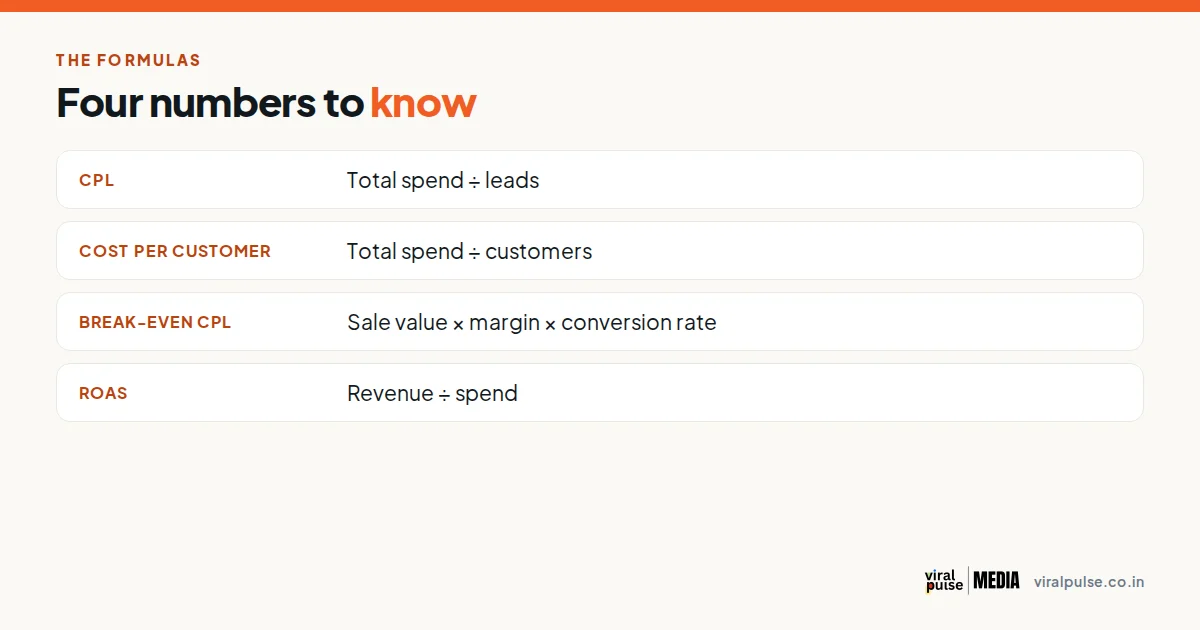
CPL = total spend ÷ number of leads
Include everything you spent on the campaign in the period you measure:
- Ad spend on the platform.
- Creative costs: design, video, photography.
- Landing page or form tools.
- Agency or freelancer fees for managing the campaign.
If you only count ad spend, your CPL looks lower than it really is. Decide what to include and use the same definition every month.
Worked Example
A coaching institute runs Meta lead ads for a month.
- Ad spend: ₹18,000
- Creative and form tool: ₹4,000
- Freelancer management fee: ₹3,000
- Leads received: 125
Total spend ₹25,000 ÷ 125 leads = ₹200 per lead.
What Counts as a Lead?
A lead is a person who has given you a way to contact them and shown interest: a form fill, a WhatsApp message, a call or a booking request. Be consistent. If you count every form fill, including fake numbers and test entries, your CPL will look better than it should. Many businesses track two levels:
- Raw leads: every submission.
- Qualified leads: people who match your target customer and can be reached.
Calculate CPL on the number you will actually try to sell to.
CPL, CPA, CAC and CPC: What Is the Difference?
| Metric | What it measures | Formula |
|---|---|---|
| CPC (cost per click) | Cost to get a visit | Spend ÷ clicks |
| CPL (cost per lead) | Cost to get an enquiry | Spend ÷ leads |
| CPA (cost per acquisition) | Cost per defined action, often a sale | Spend ÷ actions |
| CAC (customer acquisition cost) | Cost to win a paying customer, usually including sales and marketing costs | Sales and marketing spend ÷ new customers |
CPL sits in the middle of the funnel. It is useful for comparing channels, but it ignores what happens after the lead arrives. Our CPC calculator and CAC calculator cover the other steps.
The Number That Matters: Break-Even CPL
A cheap lead that never buys is not cheap, and an expensive lead that buys is not expensive. To judge your CPL, work out the most you can pay for a lead and still make money:
Break-even CPL = average sale value × profit margin × lead-to-customer rate
Example: your average sale is ₹8,000, your profit margin is 35% and you convert 8% of leads into customers.
₹8,000 × 0.35 × 0.08 = ₹224
So you can pay up to ₹224 for a lead on the first sale before you lose money. With a CPL of ₹200 you make a small profit; at ₹300 you lose money unless repeat purchases make up the difference. If your customers buy again, you can afford a higher CPL, but plan on the first sale and treat repeat business as a bonus.
This also shows the two levers: lower your CPL, or raise your conversion rate. Improving the close rate from 8% to 12% raises your break-even CPL from ₹224 to ₹336 without changing your ads.
What Is a Good Cost Per Lead?
There is no single good number, because industries, offers and customer values differ so widely. Published benchmarks give a sense of scale, but they are mostly US-dollar figures from US advertisers, so they are not a target for Indian businesses:
- Search Engine Land, reporting WordStream data, put the average Facebook lead-ad cost per lead at about $27.66 in 2025, up about 21% from $23.10 the year before.
- The same publication reported Google Ads lead costs varying hugely by industry, with legal services among the most expensive and auto repair among the cheapest.
- B2B sources report much higher numbers. Metadata.io's benchmarks, for example, show B2B costs per lead far above consumer averages.
Different providers measure different industries, platforms and time periods, so their figures often disagree. Use benchmarks to check you are in a sensible range, then judge your own results by break-even CPL.
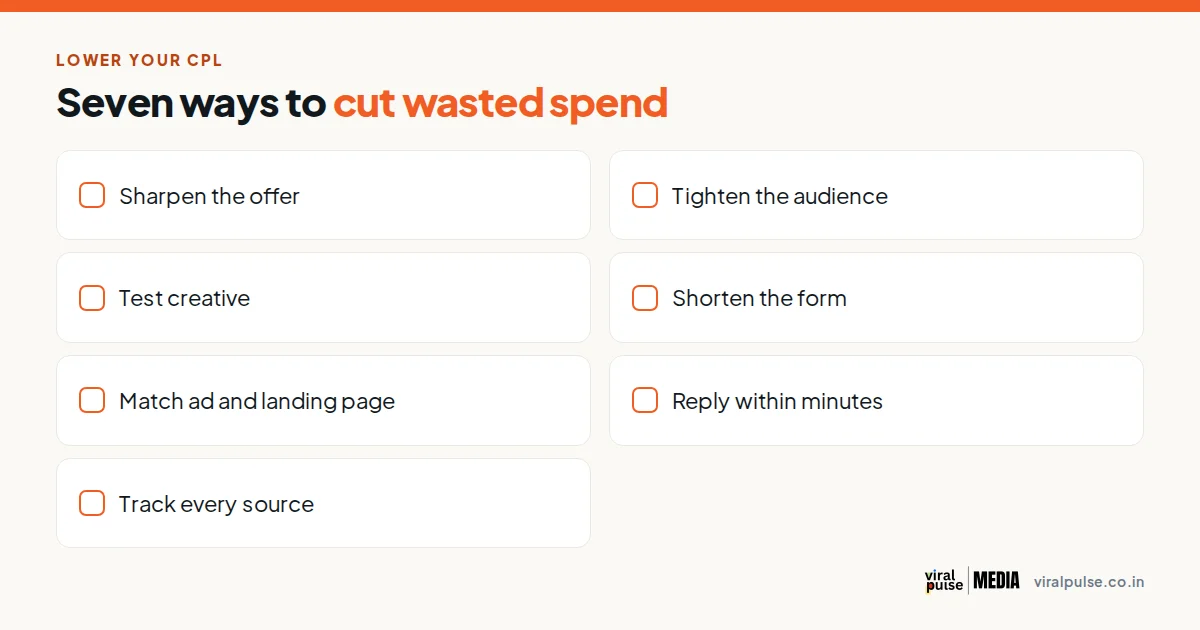
How to Lower Your Cost Per Lead
- Fix the offer first. A clear, specific offer, such as a free demo class or a free site visit, usually beats a vague one.
- Tighten the audience. Excluding people who will never buy lowers wasted clicks. Use location, age and interest filters sensibly.
- Test creative. Run two or three versions of the headline and image or video, and cut the weakest after a fair test.
- Shorten the form. Every extra field loses some people. Ask only what you need to follow up.
- Match the ad and the landing page. The promise in the ad should be the first thing people see on the page.
- Reply fast. Leads contacted within minutes convert better than leads contacted next day. Fast replies do not lower CPL, but they raise the value of every lead you pay for.
- Track the source. Use UTM links so you know which campaign and creative each lead came from.
Mistakes to Avoid
- Judging a campaign after a few days or a handful of leads. Wait for enough data to see a pattern.
- Comparing CPL across channels without comparing lead quality.
- Counting spam or fake leads.
- Forgetting costs like creative and agency fees.
- Chasing the lowest CPL. The cheapest leads often come from people least likely to buy.
- Ignoring the follow-up process, which decides how many leads become customers.
Example: Comparing Two Channels
| Meta lead ads | Google search ads | |
|---|---|---|
| Spend | ₹25,000 | ₹25,000 |
| Leads | 125 | 50 |
| CPL | ₹200 | ₹500 |
| Customers | 8 | 9 |
| Cost per customer | ₹3,125 | ₹2,778 |
Meta gives a much lower CPL, but Google's leads convert better, so its cost per customer is lower. This is why we recommend watching cost per customer alongside CPL. The same logic applies if you want to see the return on ad spend with our ROAS calculator.
Frequently Asked Questions
What is cost per lead?
Cost per lead is the average amount you pay to get one lead, calculated as total campaign spend divided by the number of leads.
How do you calculate cost per lead?
Divide your total spend by the leads generated. For example, ₹25,000 spent for 125 leads gives a CPL of ₹200.
What is a good cost per lead in India?
It depends on your industry and what a customer is worth. A good CPL is one below your break-even CPL, which you can work out from your average sale value, profit margin and conversion rate.
What is the difference between CPL and CAC?
CPL is the cost of an enquiry. CAC is the cost of winning a paying customer, so it also depends on how many leads you convert.
How can I reduce my cost per lead?
Improve the offer, narrow the audience, test creative, shorten the form, match ad and landing page, and track which sources bring real customers.
Should I count unqualified leads?
Track both. Report raw leads for volume and qualified leads for the true cost of reaching people you can sell to.
Want Leads That Turn Into Customers?
We build and measure lead campaigns around cost per customer, not just cost per lead.
Final Thoughts
CPL is only the start. Work out your break-even CPL, track cost per customer and improve your follow-up. When you are ready, put your own numbers into the free cost per lead calculator.
Want this executed for you?
Our agency team builds and runs social engines for B2B and SaaS brands.
Written by Mehran Shahmiri
Founder of Viral Pulse Media. Started as a freelance social media marketer in 2021, and is based in Srinagar, Kashmir. Also founder of OpenLoop Systems.
Follow on LinkedIn →