
Table of Contents
- Method 1: Percentage of Revenue
- Method 2: Work Backwards From a Goal
- What to Include in the Budget
- How to Split the Budget
- Keep a Testing Share
- Track What Each Channel Delivers
- Example: Putting It Together
- Common Mistakes
- Frequently Asked Questions
- How do I calculate a marketing budget?
- What percentage of revenue should a small business spend on marketing?
- What if I have no revenue yet?
- Should I include salaries?
- How often should I review my marketing budget?
- Final Thoughts
The simplest way to set a marketing budget is to take a percentage of annual revenue: 8% of ₹50,00,000 is ₹4,00,000 a year, or about ₹33,333 a month. A better way is to test that number against your goal. If the budget per new customer is lower than the profit you make on a first sale, the plan can pay for itself.
You can try your own numbers in the free marketing budget calculator.
Method 1: Percentage of Revenue
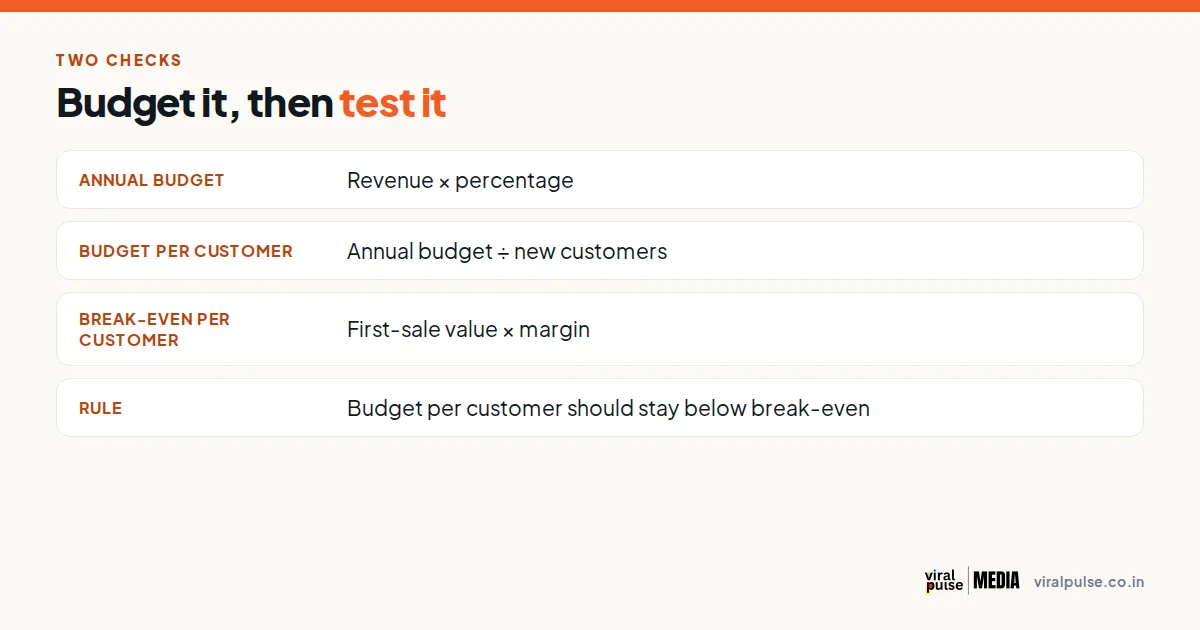
Annual budget = annual revenue × marketing percentage
Example: a clinic with ₹50,00,000 annual revenue chooses 8%.
- Annual budget: ₹4,00,000
- Quarterly: ₹1,00,000
- Monthly: about ₹33,333
- Weekly: about ₹7,692
There is no universal percentage. The right figure depends on your stage, margins, competition and growth goals. A young business trying to grow fast often spends a larger share than an established one defending its position, and a high-margin business can afford more than a thin-margin one. Use any rule of thumb as a starting point, not a target.
Method 2: Work Backwards From a Goal
Percentages ignore what you want to achieve. Working backwards starts with the goal:
- How many new customers do you want this year?
- What is the average value of their first sale?
- What is your profit margin?
- What is the most you can pay to win one customer and still make money?
Break-even cost per customer = average first-sale value × profit margin
Example: the clinic wants 120 new patients a year. The average first visit brings in ₹15,000 at a 35% margin.
- Profit on a first visit: ₹15,000 × 0.35 = ₹5,250
- Budget per new patient: ₹4,00,000 ÷ 120 = ₹3,333
₹3,333 is below ₹5,250, so the plan can pay back on the first visit. If the budget per patient were above ₹5,250, the clinic would need repeat visits, a higher fee or a smaller budget. See the CAC calculator for your real acquisition cost once you have data.
What to Include in the Budget
- Paid ads on Google, Meta and other platforms.
- Content, design, photography and video production.
- Marketing tools and subscriptions.
- Agency or freelancer fees.
- Events, printed material and local promotion.
Decide whether in-house salaries count. Many small businesses leave them out and track them separately. What matters is to choose once and stay consistent.
How to Split the Budget
The calculator offers four illustrative starting splits, which are examples and not benchmarks:
| Channel | Balanced | Paid ads first | Content and SEO first |
|---|---|---|---|
| Paid ads | 30% | 50% | 15% |
| Content and SEO | 25% | 10% | 40% |
| Social media | 20% | 15% | 20% |
| Email and CRM | 10% | 10% | 10% |
| Tools and creative | 15% | 15% | 15% |
Local businesses such as shops, clinics and salons often shift money toward Google Business Profile, reviews, local ads and referrals. Ads usually bring faster feedback. Content and SEO build slowly, but keep working after you stop paying.
Start with the split that matches your goal, run it for two or three months, then move money toward the channels that bring customers.
Keep a Testing Share
Set aside a part of the budget, often a tenth to a fifth, for trying something new: a new platform, a new offer or a new audience. Without a testing share, you keep spending on what already exists and never learn what could work better.
Track What Each Channel Delivers
A budget only improves if you know where customers came from. Use UTM links on every campaign link, ask new customers how they found you, and compare each channel's cost per lead and per customer. Our cost per lead guide and conversion rate guide show how to calculate these.
Example: Putting It Together
A coaching institute has ₹30,00,000 in annual revenue and wants 80 new students. A new student pays ₹24,000 in fees with a 40% margin.
- Break-even cost per student: ₹24,000 × 0.40 = ₹9,600
- A 6% budget is ₹1,80,000, so ₹2,250 per student, well below break-even.
- A 3% budget is ₹90,000, so ₹1,125 per student, even lower, but it may not reach enough people to find 80 students.
The numbers say the institute can afford 6%, so the real question is whether it can find 80 students with that spend. Test it for a quarter, measure cost per enquiry and per admission, then adjust.
Common Mistakes
- Setting a percentage and never checking it against a goal.
- Leaving out tools, creative and agency fees.
- Spending everything on one channel without testing others.
- Cutting the budget the moment results are slow, before the channel has had time.
- Judging only by clicks or likes, not by customers and revenue.
- Never reviewing. Look at spend and results monthly.
Frequently Asked Questions
How do I calculate a marketing budget?
Multiply your annual revenue by the percentage you choose, then divide by 12 for a monthly amount. Then check it against the number of customers you want.
What percentage of revenue should a small business spend on marketing?
There is no single answer. It depends on your stage, margins and goals. Start from an amount you can afford and adjust using the cost of winning customers.
What if I have no revenue yet?
Use a revenue target for the year, or choose a monthly amount you can afford and work backwards to the customers it could bring.
Should I include salaries?
Decide once and stay consistent. Many small businesses include ads, tools, creative and freelancer fees and track salaries separately.
How often should I review my marketing budget?
Monthly for spending and results, and quarterly for the overall split between channels.
Want Help Spending It Well?
We help small businesses plan a marketing budget around cost per customer, not clicks.
Final Thoughts
Start with a percentage, test it against your goal, split it across channels and review it every month. When you are ready, enter your own numbers into the free marketing budget calculator.
Want this executed for you?
Our agency team builds and runs social engines for B2B and SaaS brands.
Written by Mehran Shahmiri
Founder of Viral Pulse Media. Started as a freelance social media marketer in 2021, and is based in Srinagar, Kashmir. Also founder of OpenLoop Systems.
Follow on LinkedIn →